


Our business model
Our business model
Our business model is the system we use to coordinate our resources, capabilities and partnerships to deliver lifesaving services, advance water safety and sustain a lasting impact for the communities we serve.
The resources and relationships that enable us to achieve our mission across all strategic pillars


Our ability to create and preserve value is impacted by our external operating environment, our risks and opportunities and material matters (refer to our external context).
These impacts are managed through strong governance and leadership oversight (refer to our leadership and governance).
How we will deliver on our strategy with a long-term focus
 Advocacy and prevention
 Quality rescue services
 Marketing and communication
 Fundraising
 Quality corporate governance, management and administration
Read the performance section for details.
In delivering our services, we also contribute to the United Nations Sustainable Development Goals:


Strategic trade-offs and resource allocation
To save lives today while building a resilient NSRI for tomorrow, we must make thoughtful choices about how we use resources. Financial capital sits at the centre of these decisions, but the interdependencies between all six capitals make our service delivery model possible: investment in manufactured capital (vessels and stations) depends on and enables human capital development, while intellectual capital (technology, training systems and research) amplifies the reach of social and relationship capital in communities. Natural capital stewardship shapes both operational demand and response.
The key trade-offs that shape our strategic decisions
By maintaining and diversifying income streams, we can invest in new technologies and approaches that improve outcomes. While enabling best-in-class capital investments supports operational excellence and future growth, these financial resources are also needed to maintain and upgrade established infrastructure.
The SafeTRX cost increase illustrates how external commercial dynamics can pressure internally valued tools.
The ORC programme shows how long-term capital planning creates multi-decade operational capability.
Human capital is simultaneously our greatest asset and vulnerability. Our financial sustainability depends on volunteerism, our fleet requires trained crews and our social and relationship capital (community programmes) are delivered by people who must be supported and sustained.
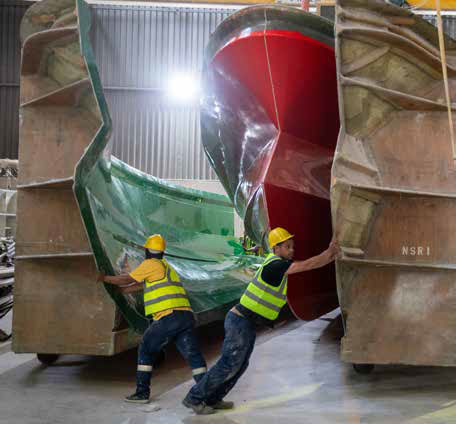
Manufactured capital is inseparable from human capital: the ORC programme requires months of crew preparation, and station expansion depends on recruiting and training new volunteers while building community trust.
Investing in the motivation, competence and well-being of employees and volunteers through support structures, recognition and skills development improves our efficiency and effectiveness. However, focusing on high-risk areas limits expansion to underserved regions.
Research (intellectual capital) informs programme design (social and relationship capital), training systems (intellectual capital) builds crew capability (human capital) and technology platforms like SafeTRX bridge manufactured capital (vessels) with the speed of response that saves lives.
Advanced volunteer training, applying innovative technology and approaches to improve outcomes, enables achievement of our goals. However, investment in this training limits our capacity to onboard additional volunteers.
Strengthening relationships with volunteers, donors, sponsors and communities fosters trust, expands safety programmes and sustains operations. Community-based programmes reduce the need for rescues over the long term but divert resources from immediate operational needs.
Community trust enables fundraising and volunteer recruitment, while education programmes create a more water-safe population, reducing future demand on rescue operations. This is a virtuous cycle, with prevention reducing the burden on reactive capability.
Environmental stewardship is an emerging strategic consideration for the organisation. Sustainable practices enhance our reputation and long-term viability by minimising the environmental impact of operations and integrating sustainability into organisational planning and decisionmaking. However, this requires financial investment that must be weighed against other operational priorities.
Our approach to environmental advocacy is measured, recognising that our diverse stakeholder base, including donors, corporate partners and local government, holds a range of perspectives. We pursue environmental responsibility through our operations and partnerships rather than public advocacy that may not reflect the breadth of views within our community. As our environmental strategy matures, this trade-off will become increasingly material.
Operational demands require continuous investment in volunteer training, rescue assets and frontline capacity. However, intellectual capital, including research, data collection and epidemiological analysis, is essential to understanding drowning patterns and shaping effective prevention strategies.
In 2025, we shifted from funding academic studies to enabling data collection and analysis through partnerships, redirecting intellectual capital investment towards outcomes that will guide long‑term prevention. This trade-off reflects the tension between resourcing immediate operational needs and building the evidence base that reduces future demand.