


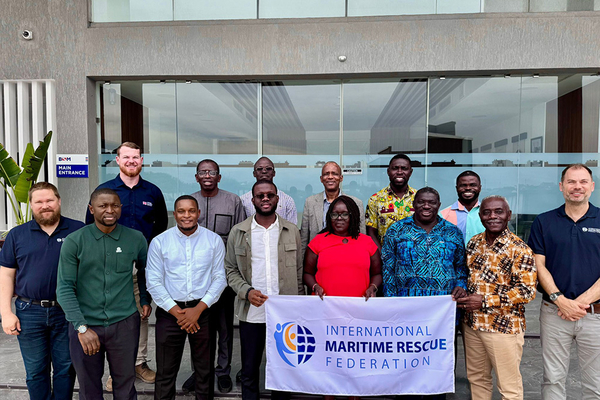
When maritime search and rescue organisations come together, the conversations extend far beyond individual rescue operations. They are about preparing for the future – sharing lessons, tackling common challenges and finding better ways to save lives.
That was the focus of the International Maritime Rescue Federation (IMRF) Global Maritime Search and Rescue (SAR) System Review Workshop held in Accra, Ghana, in June, where NSRI Regional Operations Manager Rian Basson represented South Africa.
The workshop brought together maritime authorities, rescue coordination centres, NGOs and rescue operators from nine African countries to review the continent's search and rescue capability and identify opportunities to strengthen cooperation.
For the NSRI, the invitation reflected more than participation in another international meeting. It recognised the organisation's experience, expertise and growing role within the African maritime rescue community.
Rian believes the greatest value of the workshop was the opportunity to engage directly with organisations facing many of the same operational realities.
"This was the third of four regional workshops forming part of the IMRF's Global Maritime SAR System Review. It's a rare opportunity to sit in the same room as SAR counterparts from across the continent and compare notes on capacity, funding, training and coordination,” he shared.
"The NSRI's presence matters because, as one of the continent's most established and experienced volunteer SAR organisations, we have a lot to contribute and a lot to learn from other African maritime nations."
Rather than focusing solely on presentations, the workshop encouraged honest discussions about what is working, where gaps remain and how organisations can support one another as demands on search and rescue services continue to grow.
Representing the NSRI also allowed Rian to showcase the organisation's volunteer rescue model and the work carried out every day by its crews around South Africa.
"For me, it was an awesome opportunity to showcase who we are as the NSRI, and what we do on a day-to-day basis, within the bigger scheme of maritime SAR across the African region."
His presentation covered the NSRI's operational footprint, its volunteer rescue model, rescue capability and drowning prevention initiatives, including the Survival Swimming programme. He also spoke openly about the organisation's strengths and the challenges it continues to address as maritime risks evolve.
That openness proved to be one of the workshop's greatest strengths. Capacity gaps, funding constraints, climate-related risks and the need for continued training emerged as common themes, alongside the importance of stronger regional cooperation.
For Rian, one of the biggest takeaways was the reminder that no rescue organisation has all the answers.
"No single country or organisation can absorb the full weight of a changing risk landscape – rising climate-related hazards, growing vessel traffic, and increased coastal use all put more pressure on SAR systems,” he explained.
"Sharing lessons learned means organisations aren't reinventing solutions in isolation."
As the IMRF's global review continues, the NSRI remains committed to both contributing to and learning from the international search and rescue community.
"The NSRI is well placed to keep sharing its volunteer-based model as a low-cost, high-impact template for other African maritime nations building out their own SAR capacity,” Rian said. “At the same time, we will continue to draw on international partners to close our own gaps, particularly around interoperability, inland water coverage, and technology such as drones and remote monitoring. That two-way exchange strengthens not just the NSRI, but the wider regional SAR network our own rescue region ultimately depends on."
As maritime risks continue to evolve, the workshop served as a reminder that saving lives is rarely the work of one organisation alone. By sharing experience, building relationships and learning from one another, rescue organisations across Africa are strengthening the network that keeps people safer on and around the water.

2026 Winter Solstice Plunge for a Purpose reaches record-breaking new heights
Read More
Norman Rautenbach, NSRI Richards Bay station commander, said: At 14h29, Monday, 19 October, NSRI Richards Bay duty crew were placed on alert to prepare for a maritime medical evacuation operation for 3 male seafarers injured onboard a 292-meter bulk carrier ...

A 48-year-old man from Belgium is expected to be discharged from hospital today after a non-fatal drowning incident at a remote beach between Brenton-on-Sea and Buffalo Bay on Monday afternoon. The man, on a cycling holiday with his family, is ...

On Saturday morning, NSRI Port Nolloth volunteers on a routine training exercise responded when a local mining vessel raised concern for three of her crew who had gone ashore on their RHIB (rigid hull inflatable boat) and not been heard ...