


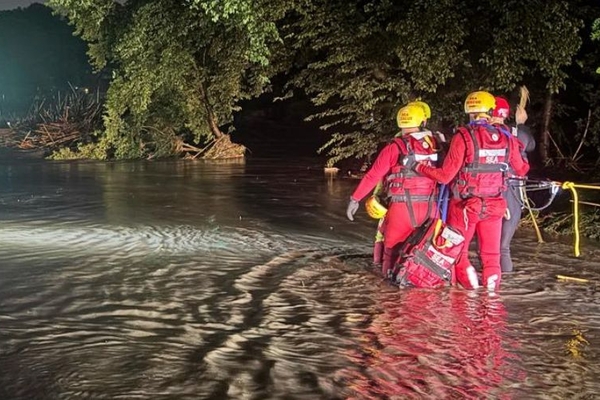
Earlier this March, heavy rains led to sudden flash flooding along the Klein Jukskei River in Randburg, prompting an urgent response from NSRI Gauteng and supporting inland stations.
Rising water threatened homes and roadways near Randpark Golf Club – one of several incidents highlighting the unpredictable and fast-moving nature of inland flood emergencies.
NSRI Gauteng’s Station 27 crew was activated and quickly deployed with swift water rescue swimmers, a rescue craft, and a support vehicle, navigating difficult conditions to reach those in distress. As emergency teams responded to reports of flooding in residential areas, a second call came in: a motorist trapped in his vehicle after attempting to cross a low-lying bridge. The car had been swept off the road and pinned against a barrier by fast-moving water.
Gerhard Potgieter, Station Commander at NSRI Gauteng, recalls the moment: “Because of the way the water was flowing, he couldn’t just get out and walk to safety. We knew it had to be a coordinated rescue.”
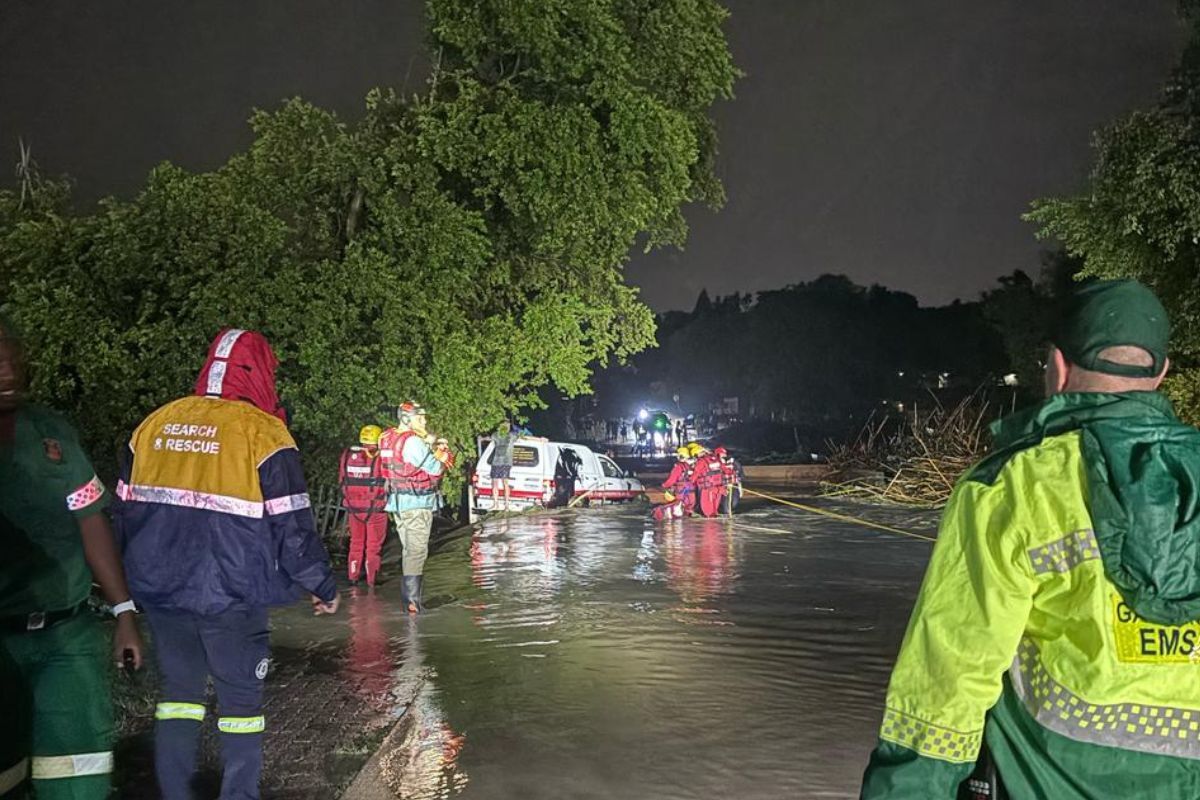
Two NSRI rescue technicians joined a rescue technician from ER24 and City of Johannesburg. SARZA erected a rope system to keep everyone in the water safe. With teamwork and careful manoeuvring, the team reached the trapped man, fitted him with a lifejacket and helmet, and brought him to safety. Fortunately, he was unharmed and required no further treatment.
Support also came from NSRI Hartbeespoort Dam and NSRI Witbank, whose crews were placed on standby and began moving toward the scene – demonstrating the high level of cooperation between inland stations. “It’s always a multi-agency effort,” Gerhard said.
Arthur Crewe, Station Commander at NSRI Hartbeespoort Dam, emphasised how inland flood response requires both readiness and flexibility. “We watch everything – weather, river levels – because when things go wrong, they go fast. Our team is trained for exactly these situations. We’re the first there and the last to leave.”
NSRI’s inland teams train regularly in real river conditions, using rope systems and rescue techniques adapted for swift-flowing, often debris-filled water. With fewer coastal-style assets and terrain-specific challenges, inland teams rely heavily on practice, coordination, and the support of local communities.
- Never attempt to cross flooded roads or bridges.
- Stay out of moving water — on foot or in a vehicle.
- If trapped, stay calm and wait for trained help.
- Call emergency services immediately.
The recent Randburg flash flooding is a reminder of how quickly conditions can change – and how prepared the NSRI’s inland teams are to respond.

The gut-wrenching realities of medical evacuations
Read More
Norman Rautenbach, NSRI Richards Bay station commander, said: At 14h29, Monday, 19 October, NSRI Richards Bay duty crew were placed on alert to prepare for a maritime medical evacuation operation for 3 male seafarers injured onboard a 292-meter bulk carrier ...

A 48-year-old man from Belgium is expected to be discharged from hospital today after a non-fatal drowning incident at a remote beach between Brenton-on-Sea and Buffalo Bay on Monday afternoon. The man, on a cycling holiday with his family, is ...

On Saturday morning, NSRI Port Nolloth volunteers on a routine training exercise responded when a local mining vessel raised concern for three of her crew who had gone ashore on their RHIB (rigid hull inflatable boat) and not been heard ...