


 While walking on the beach this month I came across a rope that was covered in goose barnacles. My children would not touch it as it seemed to be slowly writhing. They thought it was a sea-snake in the process of dying.They haven’t been the first nor will they be the last to think this. An internet search revealed that Waikanae beach near Wellington, New Zealand had a 14-metre tentacle-covered mass that people initially thought was some sort of new fantastic sea monster. This made local news and even became an instant tourist attraction.
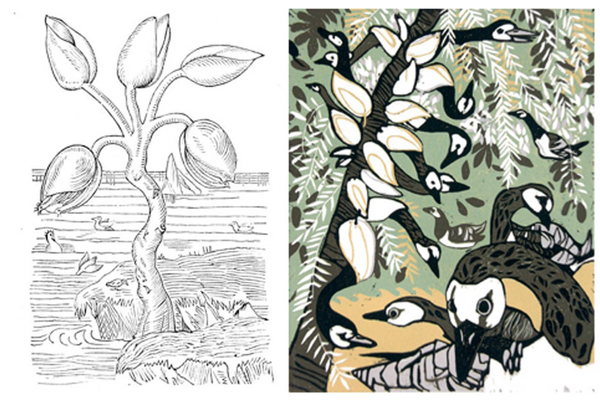
 Goose barnacles (order Pedunculata); also called stalked barnacles or gooseneck barnacles, are filter-feeding crustaceans (shrimps and crabs) that live attached to hard surfaces of rocks and flotsam in the ocean and are found washed up in intertidal zone.The name goose barnacle comes from Medieval times, as no-one had ever seen a barnacle goose nesting or an egg being laid. This was before we knew that birds migrate (Barnacle geese nest in the Arctic), it was thought the goose barnacle was the larval stage of the barnacle goose (Branta leucopsis), as the heart- shaped shell was believed to resemble the head of the barnacle goose. The Welsh monk, Giraldus Cambrensis, made this claim in his Topographia Hiberniae.Since barnacle geese were thought to be 'neither flesh, nor born of flesh', they were allowed by the church to be eaten on Meatless Fridays and during Lent. This belief was popular from the 13th to 18th centuries and was accepted by such knowledgeable experts as the sixteenth century English herbalist William Turner, and John Gerard, the author of Generall Historie of Plantes. However, during the Fourth Lateran Council, Pope Innocent III expressly stated that since it walked like a duck and talked like a duck, the same fast requirements applied to it as did to the duck.The clerics subsequently altered their behaviour, and apologized for running afowl of the papacy.
 A lot of media hype exists about plastic floating in the ocean and the harmful effects that plastic has on a variety of animals. In 1988 the Great Pacific Garbage Patch, also described as the Pacific Trash Vortex, was described in a scientific paper. It is located in the central North Pacific Ocean located roughly between 135°W to 155°W and 35°N to 42°N.
 Since then internet searches will tell you that the garbage patch is the size of Texas or larger. I found an internet site that offered trips to see Trash Island. This is rather ironic as you can’t see the island, as it depends on what data you use to describe it. Most of the trash is made of exceptionally high concentrations of pelagic plastics (LDPE, HDPE, Polypropylene, and foamed plastics which float on the oceans surface), chemical sludge, and other debris; 80 % of which have come directly from land and become trapped by the currents of the North Pacific Gyre.Sunlight and wave action cause these floating plastics to fragment, breaking into increasingly smaller particles, but never completely disappearing; at least on any documented time scale. These concentrations of submerged particles are not visible from space, nor do they appear as a continuous debris field. Instead, the patch is defined as an area in which the mass of plastic debris in the upper water column is significantly higher than average.Most of the research on plastic trash circulating in oceanic gyres has focused on the North Pacific, but there are 5 major oceanic gyres worldwide, with several smaller gyres in Alaska and Antarctica. A recent visit to Cape Town by the 5 Gyres project (http://5gyres.org) was quite an eye opener. They took samples every 160 kilometres using a 1 m trawl net. Each time they pulled up the trawl, it was full of plastic.Samples of these were on display at the Two Oceans Aquarium and it was scary to see just how much plastic is floating in our oceans.
 Cetaceans, all sea turtle species, and a growing list of fish and bird species (at last count, 267 species) have been documented with plastic in or around their bodies. When marine animals consume plastic trash, presumably mistaking it for food, this can lead to internal blockages, dehydration, starvation, hormone disruption, and potentially death.Besides the particles' danger to wildlife, on the microscopic level the floating debris can absorb organic pollutants from seawater, including PCBs, DDT, and PAHs (really bad chemicals). These toxin-containing plastic pieces are also eaten by small fish, which are then eaten by larger fish and eventually eaten by us...


 Because there are more Goose barnacles there are also higher numbers of the species that live associated with them. So another species that is also benefiting from more trash in the ocean is the Columbus crab.It’s called the Columbus crab as it was first found by Christopher Columbus on his voyages of discovery. It is a small crab with rectangular carapace shell, about 1 to 2 cm; they have fairly large claws for their size, and hairy fringes to their legs to help them swim. They are variable in colour and pattern from blue grey to rich ruby brown. These crabs spend all their lives drifting in the surface waters, but are not strong swimmers; hanging around and clinging on to floating seaweed, or drift wood, buoys and other articles covered in barnacles, sometimes even on turtles.


NSRI helps with Hout Bay Fire
Read More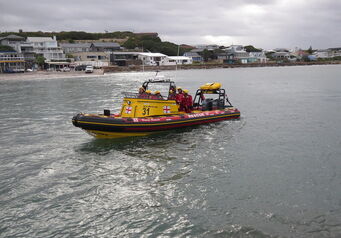
NSRI Stilbaai – Duty crew responded early Tuesday morning after a vehicle went into the Goukou River near the river mouth, resulting in the death of a 21-year-old man who was holidaying in the area with family. ...

For close to two hours, two experienced paddlers clung to their capsized surf-ski off Simon's Town, battling 40-knot winds and 2-metre swells with no way to call for help. On Saturday, 12 September, NSRI Simon's Town crew brought them home safely. ...
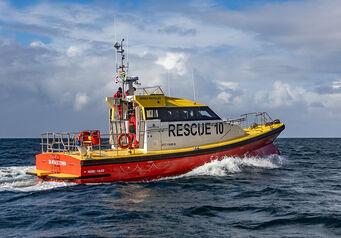
On Saturday afternoon, NSRI Simon's Town launched a dramatic sea rescue after two experienced paddlers capsized in gale-force winds and rough seas off Fish Hoek, spending close to two hours battling exhaustion and hypothermia before being found. ...