


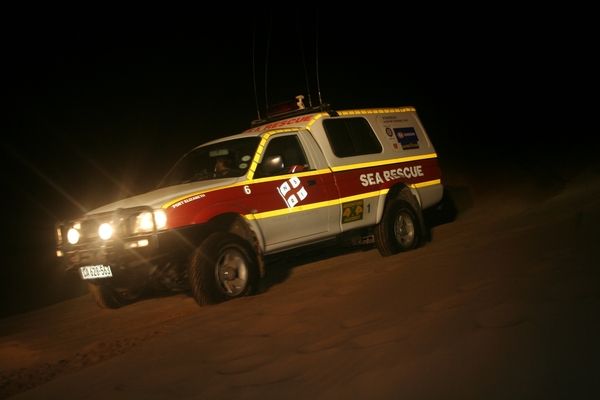
 Port Elizabeth volunteer Marcus Oshry writes about a sand 4x4 course that the Station 6 volunteers did recently:In January 2001 all vehicles were banned from driving on South African beaches. This means that 12 years ago, many 4x4 enthusiasts knew how to drive on sand as we were all allowed to do so.But now, we have a whole generation of rescue volunteers that have never driven a vehicle on sand ... which means the learning curve for a Sea Rescue Volunteer has to be very steep.As a rescue organization, Sea Rescue needs to be able to respond to some of the most remote places on our countries coastline. Negotiating sand dunes and rocky outcrops are common obstacles during a rescue operation. On the 28th and 29th of January, volunteers from Sea Rescue in Port Elizabeth went training on a farm called Brakkenduinne.4x4 Adventure Academy had organized the training as well as 2 brand new Ford Rangers from East Cape Motors, 2 Mitsubishi Tritons and a Jeep Wrangler from Maritime Motors.Sea Rescue also took out their Rescue Vehicle which is a Mitsubishi Colt.The objective of the training was to teach our rescue crew the differences between driving on sand at night versus the day. We also wanted to practice searching for lost people or aeroplanes on the coastline. Our normal sea search patterns are a lot easier to perform as there are no mountains, forests or sand dunes to get in the way. At sea we can go in a straight line. Out in the dunes fields, there are so many more variables to consider.The training session started with us all arriving and setting up camp. The site at Brakkenduinne is stunning. It is set on the bank of a man made dam which supplies water to the local farmers to irrigate 600 hectares of crops. We setup our tents and let down our tires. For the normal road user, the pressure that you need to deflate your tires for on sand would cause you to think we were nuts. For the type of sand we were going to be driving on, our tires needed to be at 0.8 bars. When you look at the tire at this pressure, your mind boggles as to how it stays on the rim.After a quick kebab roll supper, we kitted up and headed out into the dunes. We had a mix of experience among the crew. Some of the crew had never been sand driving which proved to be an interesting dynamic amongst the group.
 As soon as we rounded the first corner and attempted to climb the first narrow path up a steep dune, the chirping fell silent. Not many people got up the first dune on their first attempt. It was an S-bend with cross-overs half way up so if you didn't have momentum, you would panic, spin your wheels and dig yourself in. We purposely didn't mention the dune to the following convoy as we wanted the crew to realize that the training was serious and that the type of driving we were about to do wasn't that easy. Needless to say after a number of people failed to get to the top of the dune on their first attempt, we had their attention.The trick for sand driving is simple. Deflate your tyres for maximum traction and a bigger footprint. Make sure that you select the right gear from the start. Changing gears while trying to climb a sand dune is a fatal error as you loose momentum very quickly as well as torque.Being able to control your natural instincts is probably the most difficult of the disciplines. Naturally if you feel as though you are getting stuck in a vehicle, you try and accelerate out of the problem area. This is the worst thing you can do on sand. As soon as your wheels start spinning, you dig yourself into the sand and come to an abrupt halt.These disciplines are easy to learn in theory, but without practicing them on a regular basis, your natural instinct overrides what you have learnt and you get stuck over and over. The only way to get good at sand driving it to practice it.Once we had got all of the vehicles onto the dunes, we got together and briefed the crew on what we were planning on achieving during the night. The first exercise would see all the vehicles going on a drive through the dunes as a convoy to orientate themselves with the area as well as with the car that they were driving.They would need to swap cars and try all the different types of 4x4's that we had at our disposal. Each vehicle is different. They have different ratio's within their gear selections and when it comes to sand driving, you need to know which is the best gear to be driving in. I know my Toyota 3L D4D very well and know that for sand driving the optimal gear is 3rd Low Range. I can take my car anywhere on the sand in that gear.
 When I got into the Tritons, their optimal gear was 1st gear hi range. When it came to the new Ford Rangers, they were Automatics with a 6 speed box and tiptronic. This posed another challenge as when you engaged low range, you would have to disable the traction control, select tiptronic, otherwise the car tried to select a number of gears for you while driving on the sand and being computerised, it also tried to think for you.It took quite a bit of getting used to the automatic gear box but the vehicle was still very capable. Although you had to a lot more thinking before you pulled away to tackle a dune. You almost need a check list before you set off. Another difficulty in the dunes at night is being able to see the rise and fall of the terrain. This also takes a lot of getting used to. Once everyone was familiar with all the vehicles, we started with the scenario training.The first scenario we gave the crew was that there was a downed microlite in the vicinity of Brakkenduinne dune fields. We gave them a search block where they were allowed to search and set them on the way.
 Our Sea Rescue station has a laptop with Garmap Mapsource and the crew needed to organize themselves into search teams and to work out their search pattern. This proved to be quite interesting as we were so used to setting out search patterns over water where we mostly search in straight lines. The crew tried to do a similar type of search pattern but soon realized that when they were out in the dunes in their 3 teams of 2 vehicles each, that they started going in circles and crossed each others paths on a regular basis. The search was a success but once we debriefed the scenario, we realized that we needed to brainstorm a better method of searching in this type of terrain.The second scenario was to search for 2 downed pilots. The crew were once again told where the search area was located and this time they decided to draw a rectangle over the search area. Each corner of the rectangle was documented and the co-ordinates were taken down by all 3 search teams. All 3 search teams were told to head for the first corner of the rectangle.The JOC vehicle then headed for the adjacent further most corner of the rectangle and found a high point and shone his lights in the direction of the corner where the 3 teams were starting. From this point, the 1st search team was to find the first track pointing in the direction of the JOC Vehicle and follow that track towards the JOC.The 2nd search group travelled further until they found the next track towards the JOC and then followed that towards the JOC. The 3rd group went even further and found another track towards the JOC and so it went on. Eventually we had all 3 search teams following parallel tracks towards the JOC vehicle. At all times, the JOC could see the loom of the search teams lights and the search teams could see the loom of the JOC vehicle's lights. This proved to be the best method for what we were trying to achieve. The vehicles were constantly sending through their GPS co-ordinates to the JOC who was able to plot the areas that had been covered and also knew where his search teams were at all times. In no time, both “pilots” were found.After getting off the dunes at 01:30 we headed to bed as we were to rise early to tackle the dunes again, this time during the day.After waking up bright and early, we quickly had breakfast, briefed the crew on the mornings activities and headed off. This time the Adventure 4x4 Academy guys thought they would really test us and took us through some of the windy forest routes to get to the dunes.Unfortunately the first sandy hill they took us over would have tested most Dakar drivers. We spent the next 2 hours trying to get all the vehicles over this s-bend sandy hill.
 The road was even a mission to walk up! The Lead vehicle from the Academy popped over and proceeded to wait for the first of the Tritons to pop over the hill...
 Unfortunately the driver was new to not only sand driving but also to being in a 4x4! As he descended into the bowl of the corner, he turned the wheel and accelerated. This put him out of the track and into the trees. Luckily no damage to the Triton but it did make for some good banter. Over the next 2 hours everyone attempted to get their respective vehicles over the dune.
 The 2 Tritons were too light in the rear and had no chance with the soft powder and had to be snatched over the top. The trusty Toyota was up next and she popped over no problem. Not sure if it was the ability of the driver or vehicle... The 2 Ford Rangers were much heavier vehicles and had a great set of tires on them. The vehicles themselves got over the obstacle but some of the drivers had to give up after 5 or 6 attempts. Most of the drivers downfall was powering on too early and not staying on the track at the corner and powering themselves into the bush.The next problem they had was that if they made the corner, they would just put their foot flat on the floor which caused the wheels to spin and caused the vehicle the loose traction and in turn, the loss of momentum. The trick was to power slowly through the corner and as you felt the wheels bite into the corner, accelerate gradually until momentum was gained and then to hold the accelerator there. If you started to loose traction, you needed to come off the power slightly and not accelerate. Trying to teach this to new 4x4 drivers is very difficult but after many attempts and practice runs, the logic started to make sense.
 After 2 hours of playing on one hill, we eventually got onto the dunes to see the terrain that was covered the night before. We tried some really difficult dunes and to all the crews credit, they tackled them with conviction and guts. The 2 hours of practicing on the first dune and the nights driving, really helped teach the drivers about true sand driving. After a great days fun on the dunes, nobody got themselves into any situation where spades were needed or winching were necessary.It was a great 2 days of hardcore training.



Kinders so opgewonde oor WaterWise
Read More
The National Sea Rescue Institute’s (NSRI) newest Offshore Rescue Craft (ORC), Spirit of Ubuntu, has completed her journey from Table Bay and arrived at her new home at NSRI Station 8 Hout Bay yesterday, 19 August 2026. ...
Dog rescued after being swept 200 metres out to sea off Pollock Beach, Gqeberha ...
NSRI Honours Grootdraai Dam Rescue, Wilderness Surfer's Bravery, and 55 Years of Service at 59th Awards Ceremony and Annual General Meeting ...