


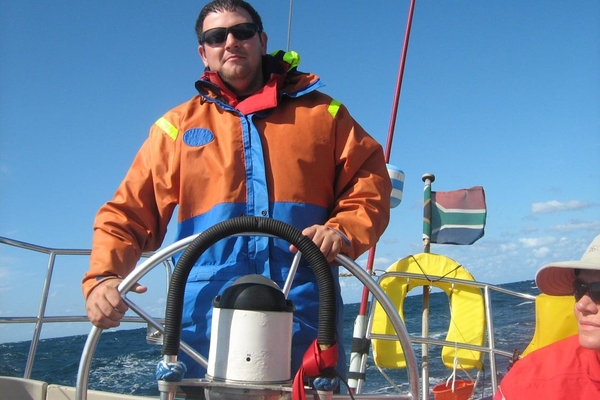
 Jacques Kruger, a crewman at St19, was selected to attend the Offshore Sailing Academy course, held in Durban, on behalf of his station. The course is valued at R8000.00 per person and Offshore Sailing Academy (Libby and the late Chris Bonnet) kindly donated 10 training spots to NSRI crew.This is Jacques’ diary on his experience:
 Offshore Sailing Academy Combo course (Yacht hand & Yacht Skipper) 20th-28th April 2011DAY 1I arrived at the offices of Offshore Sailing Academy at around 07h45 on the morning of Wednesday the 20th April to a very friendly welcome by the office staff. After Shane Smith, the principal of O.S.A, greeted me, I was shown to their students area and shown the heritage and history of this academy. The walls are covered in pictures of courses held over the past 32 years, and of historical South African yachting history news clippings.Once I stepped into the class room it held a similar story, but more in terms of training pictures and situations.It is a perfect sailing learning environment and has a feel of the passion of sailing. In the class I met two fellow students who I would be joining on the yacht hand portion of the course, Mark and Tanya from Jhb.Our Instructor for the yacht hand section then walked in. Shane Houdin, at 21 years of age, already has his full yacht masters ticket. He started with OSA 2 years ago, and has a good number of sea miles under his belt.Lectures for day one started with the basics; terminology, knots, weather and how a sailing vessel works. Throughout most of the course we had a morning lecture on a specific thing, then we went to sea to run through what we had learned.At 11h00 we went down to the yacht we would be using on the course, a Beneteau 440. It is the flagship of the OSA fleet and it’s not hard to see why. We got shown how to rig the boat as the 1st few days we had to learn the manual and basic way of doing everything. We were given harnesses to wear and instead of running with the roller furler Genoa, we would be using a flying forestay and a smaller No. 3 hank on jib.We then set sail into a good 20 to 30kt north easterly. We did helming tacks( turning through the wind) gibes (turning the stern through the wind) and thereafter learned the process of dropping a mainsail correctly and packing the jib neatly on the foredeck.Day 2The day started with pre rigging the boat before lectures, setting up the jib and the sheets (lines used to control sails). We then went up to the lecture room where we got given the synoptic chart and had to do weather predictions for the day which ended up being a good 20 to 30 knot southwester ... very good for bay sailing.The lesson of the day was anchoring and we went into depth on the length of chain / warp to use for the depth and also what factors to look for when anchoring. Following that we touched on a very important topic : The Rule of the Road ... with regards to two sailing vessels, two power vessels and also sailing and power vessels. We then went down to the boat and decided to put in a reef as the wind was peaking at 35 knots in the Port of Durban. ‘Pursuit’ our Beneteau 440, was more than capable to take this wind on, she is a very solid, stable cruising boat. As we started sailing we put into practice some rule of the road as Durban is a very high traffic port. We came across everything from tugs to ships and various other recreational craft.We sailed out to vetchies to do some anchoring which is not easy to do in 35 odd knots of wind. We had good practice as it had to be done a good 4 times before the anchor took, eventually it took hold, and we then sat and monitored it over an hour ... and discovered that we were dragging ... so up’d anchor and motored back to our dock at Durban Marina.
 Day 3Today’s theory consisted of man over board situations and how to react. We were then introduced to our new boat as Pursuit had gone for a mileage trip to East London. The boats name is Nina. She a 34ft Beneteau which I must admit is a clearly a “don’t judge a book by its cover” type. She doesn’t look like much compared to Pursuit and I must admit after living on board her for the remaining time that I was there, and sailing on her, for me anyway, she’s an awesome little boat.According to our instructor this vessel has already done two circumnavigations!We put to sea, and just offshore Durban we threw a fender overboard ... MAN OVER BOARD! was called and the boat was put on a beam reach, the spotter counted 5 boat lengths, then we tacked around to an opposite beam reach and simultaneously released the jib allowing it to luff (flap in the wind) as we bear down on our man (fender in this case). We brought the boat up into the wind at the last minute and released the main to luff. As this happened we had our casualty to leeward and we retrieved him.In lectures we also spoke about the different ways that someone who is hurt or unconscious in the water can be brought aboard. This ranged from a sling to using sails and halyards (lines used to hoist sails). It was a good exercise.DAY 4The last day of the Yacht Hand Course, we got introduced to basic navigation on charts, and the calculations between true and magnetic bearings. We spoke about taking bearings and fixes. Lectures also involved the IALA Systems of buoys and the various meaning and flashing sequences.Today’s goal was to sail far offshore and to take bearings off charted towers and lights. We sailed a good 6nm offshore to a point where we got taught how to heave to, a process in which one can stall a boat. She will more or less hold herself into the sea, a process used by sailors as a tactic to weather storms, or for solo sailors to get some sleep.We took Bearings from 3 points, Port Control , a water tower and a building. Shane Houdin took the bearings down and marked out GPS position to use as an exercise the next day. We then had a very good sail around Durban bay.Day 5, 6Day 5 and 6 we had very little to no wind, so more time was spend on theory. We also started our yacht skipper portion and 3 new people joined our class. Arthur, Clive and Craig. They had done the yacht hand course earlier this year and now wanted to finish the yacht skipper portion. With the new portion of the cause came a new instructor. John Whittle an ex pro big-wave surfer, a man passionate about the sea, sailing, surfing and so on.He started out in ‘93 doing a sailing course with the ocean sailing academy, doing his skippers in order to sail his 30 ft trimaran ‘Trinity up to Madagascar to go and find good surfing spots.Day 7We did a night entry into Durban, launched at round 4, sailed offshore Durban in the pouring rain and a strong wind. We had a view of the city of Durban at night ,and also got a good understanding of the IALA. A system, where-by the buoys are set up to enter a harbor with your port buoys to your port side and starboard buoys on your starboard side. We also learned the new leading light system in Durban, which is very interesting and clever. Instead of having two lights to line up there is one light. For example if you are far to the starboard side of the channel you will see a fixed green, if you move towards the centre of the channel the light will be flashing white and green, and when one is in the centre its fixed white. Once in the port one could then identify what bouys are cardinal markers and the various lights that different ships carry.Day 8No lectures today. We got given 3 sets of navigation questions ... one set was a course to steer. The next set was to estimated our position and then we got given a basic reality ... taking all we learnt and making a reality of it.We had good wind today. A good 25 knot southwester. We put to sea with a single reef and number 3 jib, and went through boat handling under inclement weather conditions. As the conditions out there got stronger we put in another reef (make the sail smaller) to show how it makes the boat more controllable. We were out at sea for a good 3 hours.Day 9Exam day. Everything in the book was thrown at us, but we all did well in the end. It was sad to end an amazing 9 day training session.I would like to thank Libby Bonnet and her team for an amazing experience and their high level of training. From being in their classrooms and offices one can feel and see the amazing heritage and history this school has. And see what they are doing for South African yachting. I’m proud and grateful to have been one of many that have past through your academy. Keep doing what you do!Jacques KrugerN.S.R.I Station 19 Richards Bay

Yzerfontein – 02 May, 2011: Yacht assisted:
Read More
NSRI Plettenberg Bay duty crew were activated following a request for medical assistance from a group of hikers reporting a female in their group suffering an injury and unable to continue on the walk. ...
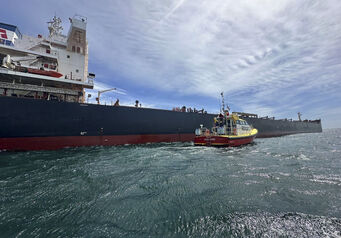
NSRI Table Bay carried out a maritime medical evacuation of a seriously injured 30-year-old Filipino seafarer from a 229-metre cargo ship, 12 nautical miles offshore of the Port of Table Bay. ...

Two local men are safe after NSRI Shelly Beach crew towed their disabled jet-ski to Ramsgate Beach on Friday, 16 October, after it drifted about 4.5 kilometres offshore of Southbroom Beach. ...