


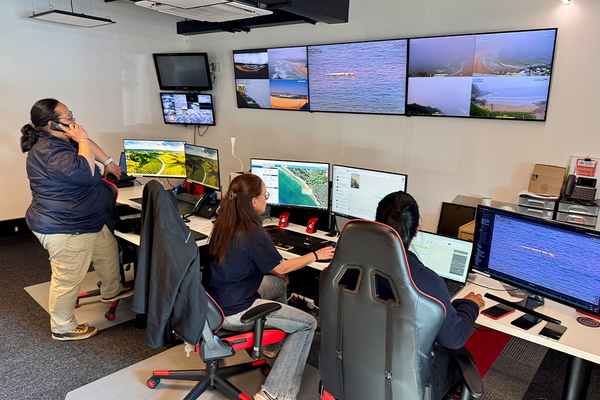
What began as an ordinary afternoon at Strand Beach quickly became a race against time when a swimmer was caught in a powerful rip current. As NSRI operators in the NSRI’s Emergency Operations Centre watched anxiously from their screens, an unexpected rescuer arrived just when he was needed most.
During a routine Beach Safety Camera check at the NSRI's Emergency Operations Centre (EOC), NSRI operator Lezhae Snyders spotted a swimmer struggling to make his way back to shore at Strand beach.
"I zoomed in with the camera and observed a person who appeared to be struggling while swimming towards the shallows. It soon became evident that the person was caught in a rip current," Lezhae recalls.
The 26-year-old man had been caught in a flash rip – a rip current that can develop suddenly, pulling unsuspecting swimmers away from the beach.
Lezhae immediately raised the alarm.
Supervisor Rizia Khan jumped on the phone to emergency services, while Training Assistant Melodie Herrmann checked the NSRI's SafeTrx app for nearby paddlers who might be able to assist. NSRI Station 9, Gordon's Bay and other emergency responders had been activated.
As this was happening, NSRI Communications Manager Andrew walked into the EOC and immediately sensed the tension.
On the screens, the swimmer was desperately trying to make his way back to shore, but the current was proving too strong. With lifeguards not yet on seasonal duty, the team knew it could take precious minutes for rescuers to arrive.
The swimmer was becoming increasingly exhausted. He repeatedly tried to swim against the current, turning onto his back at one point before attempting to swim again.
"We were watching a man fight for his life," Andrew recalls.
Then, just as the situation appeared increasingly desperate, something remarkable happened.
"Suddenly, out of nowhere, a surfski came blasting into the frame. He was paddling hard. Straight at the head in the water," Andrew says.

The paddler, later identified as Johan Otto, had spotted the struggling swimmer and raced towards him.
As the EOC team watched, Johan jumped off his surfski and pushed it towards the exhausted man, giving him something to hold onto.
Another bystander swam out to assist, and together they began guiding the swimmer and surfski towards shore.
NSRI rescue swimmers arrived shortly afterwards to help bring everyone safely back to the beach. The swimmer was then assessed by paramedics and transported to hospital for further medical attention. Thankfully, he is expected to make a full recovery.
For Johan, knowing that everyone was safe was what mattered most. In his mind, he had done what anyone else in his position would have done and was grateful that the incident had ended well.
While Johan's quick thinking undoubtedly helped save a life, the rescue also demonstrated the vital role of the NSRI's Beach Safety Camera network and EOC.
Throughout the incident, Lezhae maintained visual on the swimmer, allowing operators to update emergency responders on his exact location.
"A trained operator watching the feed can spot someone in difficulty, sometimes before anyone on the beach notices, and raise the alarm right away," explains Rizia.
For Andrew, who spent years responding to emergencies himself, watching the rescue unfold from a control room was an entirely different experience.
Instead of rushing to the scene, he witnessed the immense pressure on operators who must coordinate assistance while watching someone in distress.
"I have a whole new respect for Emergency Operations Centre operators. It’s a job that needs a sharp mind and nerves of steel," he says.
This rescue is also an important reminder of how quickly conditions can change in the ocean.
Flash rips can form suddenly, even where the water appeared calm moments earlier. Swimmers may find themselves unexpectedly pulled away from shore, and attempting to fight the current can quickly lead to exhaustion.
If caught in a rip current, remember:
• Stay calm and avoid swimming directly against the current.
• Float on your back to conserve energy and raise an arm to signal for help.
• If able, swim parallel to the beach to escape the current before making your way back to shore.
• Always swim at beaches where lifeguards are on duty, and between the designated flags.
If you see someone struggling, alert lifeguards or emergency services immediately. Avoid entering the water without appropriate training and never enter the water to help someone without having first called for help and taking something that floats with you , as you could also become a casualty.
As this rescue shows, recognising danger early, raising the alarm and getting flotation to someone in trouble can make all the difference.

NSRI and The Little Optimist Partner to Train Water-Safety Ambassadors
Read More
Congratulations to Spencer Oldham, Station Commander at Station 8 Hout Bay, who has won the October photograph of the month with his photograph of the Station 8 JetRIB Spirit of Gabi training at Kleinmond. It’s a photograph that puts us ...

A shared belief in the power of water – and the importance of helping people enjoy it safely – is bringing the NSRI and The Little Optimist Trust together.Recently, members of the NSRI’s Community Programmes team spent two days at ...

For Rena and Roxy Du Toit, volunteering with the NSRI is more than a commitment to saving lives. It is a shared adventure that has strengthened their friendship, challenged them to grow and given them countless opportunities to make a ...