


In a drowning emergency, minutes matter.
Yet even the fastest rescue response often involves an unavoidable delay. NSRI volunteers must first reach the station, prepare the rescue craft, launch, and travel to the scene. It is a model that has saved countless lives, but when every second counts, those first critical minutes can determine the outcome.
The Responsive Rescue Swimmer Programme aims to bridge that gap.
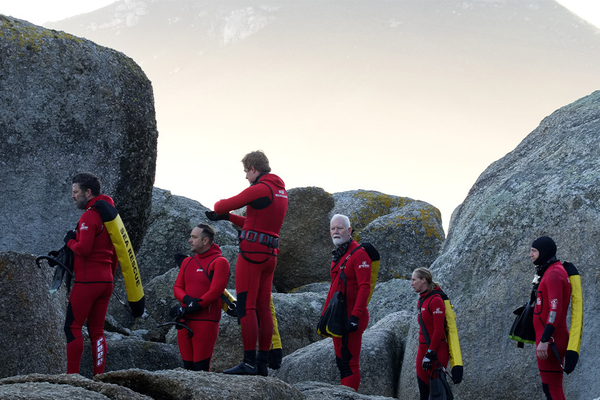
Instead of waiting for the rescue craft to arrive, specially trained volunteers can respond directly to the scene with rescue equipment carried in their personal vehicles. Their role is not to replace the rescue vessel, but to reach a casualty sooner, provide immediate assistance, and stabilise the situation until additional rescue resources arrive.
For NSRI Chief Operations Officer Brett Ayres, the programme represents an important shift in thinking about how rescue services can save more lives.
"The whole concept of the programme is about leaning into modern technology, with the information flows that we have," he explained. "Every crewman knows what the call is about. And we have volunteers who live in areas around the sea rescue station, so they can respond directly to the scene."
The idea grew from a challenge many NSRI volunteers have experienced firsthand.
For Brett, the challenge is not theoretical. As an NSRI volunteer in Durban, he often found himself responding to callouts by first heading to the station, launching the rescue craft and then travelling by sea back to an incident that was only minutes from where he lived.
Experiences like these highlighted a simple question: what if trained volunteers could respond directly to the scene while additional rescue resources were still on their way?
The concept gained momentum after being discussed at the NSRI Station Commanders' Conference in 2024. What emerged was a striking pattern: stations around the country had independently begun exploring similar ideas, each trying to solve the same operational challenge in their own environment.
Today, Stations at Bakoven, Table Bay, Hout Bay, Simon’s Town, Wilderness and Durbanare involved in various stages of implementation. Station 8 Hout Bay is leading the development of training standards, operational procedures and qualification pathways that could ultimately inform a national framework.
The ability to respond directly to a drowning emergency requires far more than being a strong swimmer.
Responsive rescue swimmers operate in challenging environments and often arrive before other rescue resources. For that reason, the programme includes rigorous fitness assessments, rescue training, operational protocols and regular reassessment.
At its core is a simple but vital question: does entering the water improve the outcome, or risk creating another casualty?
Head of Operations Charl Maritz explains that the goal is to channel people's natural desire to help into a structured and safer response capability.
"People who consider themselves strong swimmers have a natural instinct to help when they witness a drowning," Charl said. "Rather than discourage that impulse, the programme channels it. It targets those individuals, puts them through a structured qualification pathway, equips them to a defined standard, and builds in the safety protocols that distinguish a trained intervener from a well-intentioned casualty risk."
While the programme is being developed at coastal stations, its long-term potential extends far beyond the shoreline.
Over the past decade, the NSRI has invested heavily in rescue stations, rescue craft and infrastructure around South Africa's coast. Those assets remain essential, but they cannot be the only answer to a national drowning problem.
Many drowning incidents occur far from the coast, in rivers, dams and inland waterways where rescue infrastructure is limited or non-existent. Building a fully equipped rescue station in every community is neither practical nor affordable.
The Responsive Rescue Swimmer Programme offers a different approach: training and equipping local volunteers to become capable first responders within their own communities.
By empowering communities with skills, equipment and support, the programme offers a model that is scalable, community-driven and far less dependent on expensive infrastructure. As the concept evolves, it has the potential to bring lifesaving capability to places where a traditional rescue station may never be practical.
For Brett, that possibility lies at the heart of the programme.
"People are what the NSRI is about, and they are what NSRI is for," he said.
Ultimately, the Responsive Rescue Swimmer Programme is not just about responding faster. It is about empowering people and communities with the skills, confidence and capability to act when help is needed most.
And in those crucial first minutes of a drowning emergency, that could make all the difference.

Above Water: A Campaign That Makes South Africans Stop and Think
Read More
NSRI Plettenberg Bay duty crew were activated following a request for medical assistance from a group of hikers reporting a female in their group suffering an injury and unable to continue on the walk. ...
NSRI Table Bay carried out a maritime medical evacuation of a seriously injured 30-year-old Filipino seafarer from a 229-metre cargo ship, 12 nautical miles offshore of the Port of Table Bay. ...

Two local men are safe after NSRI Shelly Beach crew towed their disabled jet-ski to Ramsgate Beach on Friday, 16 October, after it drifted about 4.5 kilometres offshore of Southbroom Beach. ...