


The work of the NSRI has always extended far beyond the shoreline, but over the past year, a quiet transformation has been taking place within the organisation. Rescue crews and Community Programme instructors, who once operated largely in parallel, are now intentionally collaborating their efforts.
The result is a growing group of multi-skilled people who not only save lives in emergencies but also help prevent drownings long before they happen.
This integration is part of a broader operational restructuring led by COO Brett Ayres. As he puts it, “community programmes, what used to be known as drowning prevention, now falls into operations as a broad portfolio”. Bringing these teams closer has created new energy and a shared sense of purpose, with more than 30 water safety instructors teaching across all nine provinces. Brett describes them as “ambassadors for the NSRI who are doing a sterling job.”
One of these ambassadors is Nkazi Nyawose, a Survival Swimming Instructor in the Port Shepstone area and a volunteer at Station 20 Shelly Beach. His dual role has reshaped his understanding of the risks communities face. “As an instructor, your role is to teach at schools and in communities. You never really understand how much impact drowning has on the family of the victims until you actually witness it,” he says. “Working both roles has broadened my understanding of drowning risks. I have seen where most drownings take place, and that has driven me to want to investigate and come closer to where drownings happen and focus my teachings there.”
The Shelly Beach crew have embraced this collaboration wholeheartedly. Nkazi explains that “the guys at station 20 have owned Survival Swimming Centre 3 (SSC3) as if it were an extension of the Sea Rescue base. They show up for everything, from maintenance to cleaning, they are there. They’ve even bought supplies several times when I needed them instead of waiting for them to come from Cape Town. We are one team and their support is invaluable.”
For Nkazi, what makes the partnership work is simple: “Understanding that we all are different and have something to learn and teach one another helps a lot. No one assumes to know more than the other, but instead we teach each other, and that is what makes great teamwork.”
For Brett, this cross-pollination is not just practical but deeply meaningful. Many instructors have backgrounds as lifeguards or first aid trainers, skills that can feed directly back into rescue work. “With a little bit of training and capacitation, you can make them a rescue crew for the future,” he explains.
Exposure to rescue operations also changes the way instructors teach. “When they're standing in front of a class, they're not teaching the dangers of a rip current from a theoretical place. They're teaching it from a lived place.”
In Durban, Surf Rescue Coxswain and Regional Community Programmes Coordinator Siyabonga Mthetwa sees the benefits daily. “The strongest benefit is the shared situational awareness that develops when Rescue Services and Community Programmes work together,” he says.
Rescue teams provide real-time insights into high-risk patterns, while instructors translate that insight into targeted education. This partnership, he explains, “helps us shift from reactive responses to proactive interventions, ultimately reducing incidents.”
He adds, “It also builds trust in communities, as people see a unified NSRI presence focused on both safety and support.”
For Head of Community Programmes, Mthe Kweyama, this shift is about amplifying the organisation’s impact. His team is small, 30 instructors nationwide, but through integration, stations can “supplement their work through station volunteers”. He describes the initiative as a way “for each department and aspect of the organisation to complement each other and expand our scope of value and impact”.
Across the country, the change is already visible: volunteers teaching in classrooms, instructors joining rescue crews, and a steady blurring of lines between prevention and response. As Brett reflects, the public does not see departments or portfolios, “they just see one continuous value stream of what NSRI offers them”.
And now, increasingly, that is exactly how NSRI sees itself, too.

Two Men Rescued from Rip Currents at Wilderness Beach
Read More
NSRI Plettenberg Bay duty crew were activated following a request for medical assistance from a group of hikers reporting a female in their group suffering an injury and unable to continue on the walk. ...
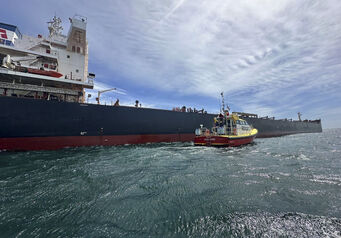
NSRI Table Bay carried out a maritime medical evacuation of a seriously injured 30-year-old Filipino seafarer from a 229-metre cargo ship, 12 nautical miles offshore of the Port of Table Bay. ...

Two local men are safe after NSRI Shelly Beach crew towed their disabled jet-ski to Ramsgate Beach on Friday, 16 October, after it drifted about 4.5 kilometres offshore of Southbroom Beach. ...