


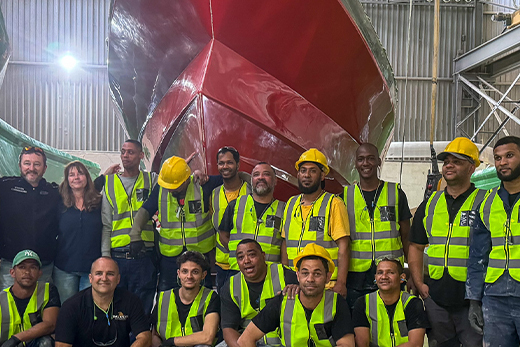
The NSRI fleet is steadily growing stronger as ORCs 7 and 8 move through the final stages of their build, bringing the organisation closer to completing a full renewal of its Class One vessels.
ORC 7 is now approaching completion. Before transport, the team installed everything that could safely fit without exceeding the maximum height for travel. Now that the hull has arrived at the harbour, the remaining components, including the fly bridge, antennas, propellers, and propeller shafts, can be fitted.
Graeme Harding, NSRI’s Head of Fleet and Facilities, explains that at this stage, it’s “mostly the final fittings and finishing touches.” The team aims to have the vessel complete by mid-December, with launch planned for the second week of January. Following sea trials and SAMSA accreditation, delivery to its station is expected in March.
Transporting a vessel of this size is no small feat. Graeme describes the operation as requiring “huge coordination… You have to have a police escort, a lead vehicle with a hot stick to make sure it doesn't hit anything, and a vehicle following behind.” He adds that another tricky aspect is only being allowed to travel between 02:00 and 04:00 in the morning.
Despite the complexities, the journey from Parrow to the harbour went smoothly, with the careful lifting and placement of the hull taking the most time.
As for ORC 8, she has just emerged from the mould, marking a major milestone in the fleet renewal programme. Graeme recalls the moment with pride: “Anytime you pop a hull out of a mould and she's 100% smooth and you know everything is in the right place and there's no bubbles… that's quite cool. Also, for us it's sort of the end of an era with that mould because at this stage it's the last ORC to be taken out of the mould.”
ORC 8 is now entering the stage where engines, gearboxes, cabling, and internal carpentry, including the chart table and dashboard, will be installed. Early March is the target for transport to the harbour, with launch expected in May and delivery to the station by June.
Once operational, these new vessels will make a real difference to NSRI operations. “The ease of operations compared to the old boats is just much easier on the crew,” Graeme notes. “You can spend longer times out at sea, they're more reliable and response times are also a little bit faster because these ORCs can run faster than the old rescue vessels.”
He adds that the investment ensures the fleet’s long-term sustainability. “For the next 40 years, we're going to be really good to go with the Class One boat, so I think that's really, really good.”
With ORC 7 (built for Mykonos) soon in the water and ORC 8 (built for Hout Bay) fresh from the mould, NSRI’s fleet is stronger than ever, ready to continue its vital work of saving lives at sea.

How Schalk Boonzaaier’s childhood dream led to a life of rescue
Read More
A 48-year-old man from Belgium is expected to be discharged from hospital today after a non-fatal drowning incident at a remote beach between Brenton-on-Sea and Buffalo Bay on Monday afternoon. The man, on a cycling holiday with his family, is ...

On Saturday morning, NSRI Port Nolloth volunteers on a routine training exercise responded when a local mining vessel raised concern for three of her crew who had gone ashore on their RHIB (rigid hull inflatable boat) and not been heard ...

NSRI Plettenberg Bay duty crew were activated following a request for medical assistance from a group of hikers reporting a female in their group suffering an injury and unable to continue on the walk. ...