


Each year in May, the NSRI’s Volunteer Support Centre (VSC) in Cape Town transforms into a specialised training ground for one of the most technical and high-risk rescue disciplines in our organisation: Maritime Extrication, or MEX.
In simple terms, maritime extrication is high-angle rope rescue adapted for the sea. But in practice, it’s anything but simple. The crews are trained to perform intricate rope operations in dynamic, often unpredictable environments – on moving ships, swaying rescue vessels, and along steep coastal cliffs.
The MEX programme is structured in progressive levels. Crews begin with the MEX Orientation course, which focuses on land-to-water operations and is especially relevant for stations like Oyster Bay, Storms River, and Knysna, where cliff rescues are more common than ship-based extractions. From there, volunteers can work their way up to MEX1 and MEX2 – higher-level qualifications involving ship extrications, patient stabilisation, and leading full rescue operations.
NSRI Training Officer Dean Wegerle explains: “MEX Orientation entails high-angle courses where they do rope rescues on buildings or cliffs – those platforms are fixed. In MEX 1 and 2, the ship and the rescue vessel below are moving. That’s a whole different set of skills.”
Training is intense. Each course runs over four days, from Thursday to Sunday, and covers everything from gear orientation to ascending and descending ropes suspended from platforms. “It’s not abseiling as most people would understand it,” says Dean. “They ascend and descend a static line, hanging from the ceiling, using specialised equipment.”
The physical and mental demands are no small part of the process. “You spend a lot of time in your harness with all your kit attached,” Training Officer Danie Verwey notes. “It’s physically and mentally demanding. Your decisions directly affect the safety of your crew and the casualty. Their lives are literally in your hands.”

At the VSC, instructors simulate real-world scenarios as closely as possible. Volunteers learn to rig anchors, manage mechanical advantage systems, and safely raise or lower people and equipment. This centralised training ensures consistent standards across stations while allowing volunteers to learn from seasoned MEX leaders.
But it doesn’t end when the course is over. Crews are encouraged to keep practising. “From the training department side, our job is to try and maintain the standard," says Danie. "We hand out rope rescue kits to the stations, do the training with them, and then encourage them to continue practising.”
With no reliable air rescue options along much of South Africa’s coastline, the responsibility of complex maritime rescues falls squarely on NSRI crews. Through rigorous training and real-life preparation, the MEX programme ensures they’re ready, whether they're navigating sheer cliffs, slippery rocks, or the towering sides of a ship in rough seas.

How Search and Rescue Training is strengthening SA’s coastal emergency response
Read More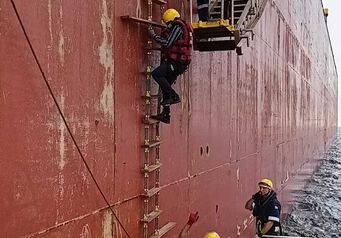
Four nautical miles off the Port of Durban, NSRI Durban crew carried out a maritime medical evacuation on Saturday, 26 September, bringing an injured seafarer safely ashore for further treatment. ...

A man has died after getting into difficulty while bodyboarding at Kenton-on-Sea middle beach on Friday, 25 September, despite the efforts of three Good Samaritans and NSRI Port Alfred crew to save his life ...
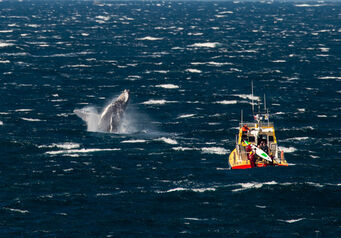
Congratulations to Charles Booysen, who took this cracking good photograph of a humpback whale breaching in False Bay, while a 73-year-old man who called for help by activating SafeTrx was rescued by Station 10 Simon’s Town volunteers on the 25th ...