


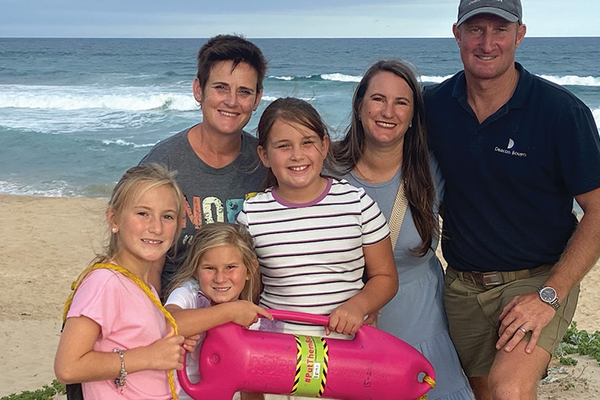
On 16 February, Klein Brak Beach became the scene of a distressing ordeal that underscored the immense value of life and the importance of preparedness in moments of crisis.
Thanks to the quick thinking of beachgoers and the presence of the NSRI’s Pink Rescue Buoy (PRB), a young girl named Stefanie was given a second chance at life.
What began as a beautiful outing for the Deacon family quickly turned into a life-threatening situation when a powerful rip current swept away three children. As panic spread along the shoreline, Quintus Deacon, a former Sea Rescue volunteer, knew he had only seconds to act. Spotting the bright pink buoy nearby, he grabbed it and raced into the water, determined to reach the struggling children.
The rescue was fraught with challenges. Stefanie, the youngest of the group, was clinging to survival amid relentless waves. As exhaustion set in, fear took hold. “Oom, are we going to die today?” she asked, her voice trembling. Though battling his doubts, Quintus reassured her: “No, we are not!”
Every second counted. With no immediate boat support and the rip current pulling them further from shore, Quintus relied on his training and instincts. Then, a moment of hope – his feet brushed the seabed. Pushing forward with renewed determination, he guided Stefanie to safety.
This rescue marks the 216th life saved by NSRI’s PRB Initiative, a testament to the power of community preparedness and swift action. The PRBs have played a critical role in numerous rescues across South African beaches, offering flotation devices that enable members of the public to intervene in emergencies. The importance of such resources cannot be overstated. Every second matters in a drowning situation, and having access to a flotation device can mean the difference between life and death.
NSRI continuously works to educate the public on water safety, particularly the dangers of rip currents. Beachgoers are always encouraged to swim at lifeguard-patrolled beaches and within designated safe zones. Recognising a rip current and understanding how to escape one are essential skills for anyone entering the ocean. In situations like these, staying calm is paramount – panic can be as dangerous as the current itself.
NSRI’s rigorous training ensures that volunteers are equipped to handle real-life rescue scenarios. They undergo extensive scenario training , including identifying and navigating rip currents under pressure. The key to success in such rescues lies in a combination of skill, physical endurance, and mental resilience. The phrase “Train as you rescue - Rescue as you train,” per Mossel Bay Station Commander JC Roos, is at the heart of NSRI’s preparation, ensuring that every rescuer knows exactly what to do when the moment comes.
The PRB Initiative continues to be a lifesaving beacon on South African beaches. This story is a poignant reminder of the importance of vigilance, education, and quick action. To those who have supported this initiative — thank you. Your contributions save lives.

Saving lives through water safety: The impact of a vital donation
Read More
Norman Rautenbach, NSRI Richards Bay station commander, said: At 14h29, Monday, 19 October, NSRI Richards Bay duty crew were placed on alert to prepare for a maritime medical evacuation operation for 3 male seafarers injured onboard a 292-meter bulk carrier ...

A 48-year-old man from Belgium is expected to be discharged from hospital today after a non-fatal drowning incident at a remote beach between Brenton-on-Sea and Buffalo Bay on Monday afternoon. The man, on a cycling holiday with his family, is ...

On Saturday morning, NSRI Port Nolloth volunteers on a routine training exercise responded when a local mining vessel raised concern for three of her crew who had gone ashore on their RHIB (rigid hull inflatable boat) and not been heard ...