


With the summer season in full swing and warmer days beckoning beachgoers to the coast, it’s important not to let our guard down to ensure we keep ourselves and our families safe.
“If you are visiting the coast, one of the simplest things you can do to stay safe this summer is to visit a beach where lifeguards are on duty and only go into the water between their red and yellow flags,” says Rebecca Carter-Smith, the Western Cape’s Lifeguard Manager at the National Sea Rescue Institute (NSRI).

“Rip currents pose a real danger and can easily catch you off guard and pull you into deeper water. Lifeguards are trained to spot these danger zones and guide beachgoers on where to enjoy the water safely.”
This year, the NSRI’s lifeguards have been entrusted to look after 65 beaches around the country, up from 21 last year. Equipped with fins, wetsuits, Malibu rescue boards, and torpedo buoys, NSRI lifeguards are well-prepared to handle water emergencies efficiently.
Beyond the water, they are prepared with first aid essentials, oxygen, and an AED (Automated External Defibrillator) to provide immediate medical assistance. Supported by advanced communication systems, including VHF radio and cell phone networks, as well as over 50 Sea Rescue base stations, beach safety cameras, and their national Emergency Operations Centre, the NSRI is ready to respond swiftly in any emergency.

"We see Lifeguarding as a comprehensive system. It involves effective training, development of lifeguards, quality equipment, and sound management," says KZN Lifeguard Manager, Mthe Kweyama. The NSRI Lifeguarding unit, having conducted 94 rescues, 106 first aid treatments, and 9402 prevention interventions in the 2022/2023 season, places a significant emphasis on prevention, aiming to proactively address potential incidents before they become emergencies.
There are many other ways you can keep yourself and others safe, such as by learning how to do bystander CPR, making sure you know to call 112 in an emergency, or having the NSRI emergency number (087 094 9774) saved in your phone before you go to the beach.
Lastly, know that alcohol is one of the leading causes of drowning fatalities and will impair your judgement and how effectively you can supervise children around water – which may put their lives at risk.

DHL Deliverer named and blessed at NSRI Table Bay
Read More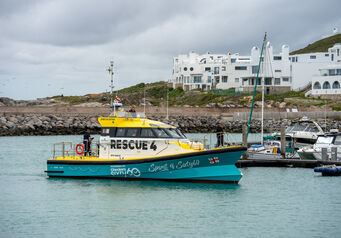
A gift celebrating a couple’s wedding anniversary. A tribute to a mother who quietly supported sea rescue. A husband’s thank you to the wife who helped him through recovery. These are some of the stories carried by Rescue 4, the ...

The National Sea Rescue Institute (NSRI) today announced the winner of its Monthly Giving draw and the winner of the second car in its 2026 Cars4Good competition, both held in support of the organisation's lifesaving work on South Africa's waters. ...

Melinda Snyman, NSRI St Lucia station commander, said: Shortly after 09h00, on Thursday morning, 8 October, a local fishing vessel capsized while attempting to launch through the surf at Cape Vidal, approximately 30 kilometres North of St Lucia. A S.T.A.R.T ...