


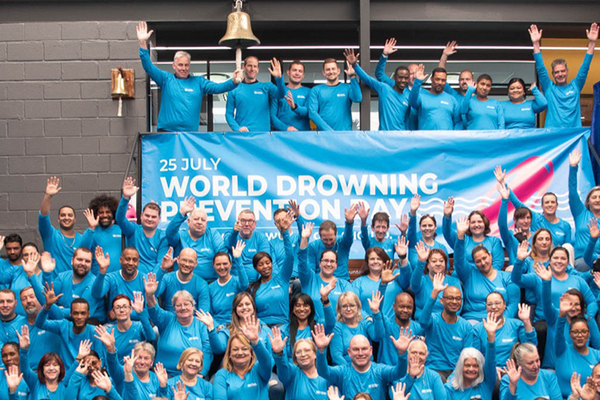
On 25 July, NSRI staff, volunteers and South Africans all over the country answered the call to wear blue. Their message? Anyone can drown – no one should.
For the NSRI, 25 July is an important date on the calendar: World Drowning Prevention Day. This year, scores of NSRI staff, volunteers and caring South Africans across the nation wore blue to champion the urgent need for action to reduce drownings. Station commanders, the entire Volunteer Support Centre (VSC) staff, as well as various schools, organisations and individuals proudly participated in the campaign in shades of teal, turquoise and cobalt, posting pics on social media using the hashtags #NSRIWDPD and #DrowningPrevention.
NSRI water safety instructors also held water safety lessons in public places and at selected schools on the day.

But perhaps the most spectacular facet of the campaign occurred on the night of the 24th: East London City in the Eastern Cape, Whalebone Pier in KwaZulu-Natal and the NSRI VSC in Cape Town were lit up with blue lights on the eve of the 25th, in remembrance of those who have drowned.

“This day is particularly significant as it has been earmarked by the World Health Organisation (WHO), which is the host of the Drowning Prevention Alliance, as well as the United Nations and many other global organisations,” says NSRI Drowning Prevention Executive Director Dr Jill Fortuin. “Middle- to low-income countries like South Africa account for the vast majority of the world’s drownings, and a substantial portion of those are children under the age of 14. The point of this day is to put a spotlight on drowning prevention. Blue clothing and lights are very symbolic: they remind us of those who have drowned needlessly, and to spread the message that anyone can drown, but nobody should.”
In addition, a day-long webinar was hosted on the 25th, with a panel of esteemed experts sharing research, insights and knowledge around Drowning Prevention, include NSRI CEO Dr Cleeve Robertson, Dr David Meddings from WHO and Mr Tom Mecrow, Senior International Evidence Manager for the Royal National Lifeboat Institution (RNLI), and various other representatives from government and rescue organisations.

“Everyone was welcome to attend the webinar, to learn from the global and expert community why drowning is an important public health concern, as well as what has and is being done to prevent drownings,” says Dr Jill.
The 25th also marked the initiation of a brand new tradition at the NSRI: the ringing of the Māori Bell for every life saved.
The bell, forged in 1893, was long considered lost after the SS Māori, a British cargo ship operating in Australia and New Zealand, ran aground in Llandudno, Cape Town.
Following years of inquiry to find out what happened to it, and through an old friend of the NSRI, NSRI CEO Cleeve Robertson discovered that the bell was on a farm in Stanford, Western Cape. In 2023, the bell found its new home at the Volunteer Support Centre, and will henceforth ring in celebration of each life saved through the work of the NSRI.
While much work still remains to be done to reduce drownings in South Africa and across the world, this important day marks a significant step towards a future in which water safety is available to all.



WATCH: NSRI Awards & AGM highlights 2023
Read More
NSRI Gqeberha crew assisted EMS in treating a fisherman who fell ill aboard a Chokka fishing boat off Port Elizabeth last night, ensuring he received urgent medical care and a safe transfer to hospital. ...
The National Sea Rescue Institute (NSRI) encourages South Africans to use National Wills Week, from 14 to 18 September 2026, to draft or update their wills and consider leaving a legacy gift that will help save lives for generations to come. ...
National Sea Rescue Institute (NSRI) Hout Bay volunteer crew recovered a Hout Bay Yacht Club (HBYC) racing buoy at sea on Saturday, 5 September, after it broke free from its mooring and was swept out into Hout Bay in gale ...