


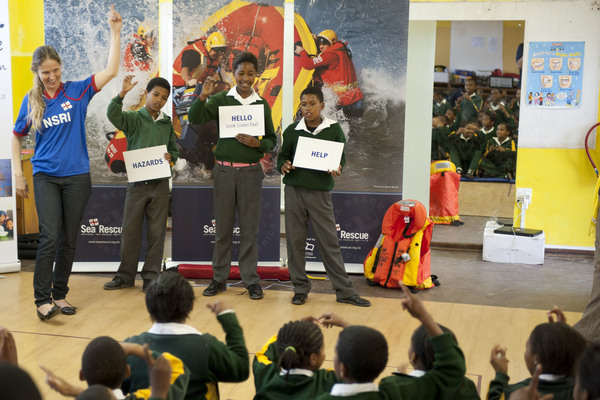
 The Easter holidays are upon us and WaterWise encourages you to have a safety plan in place before you need it. Make sure that key people in your group know who to call in an emergency and that all family members know what to do if something goes wrong.If a child is separated from your group have a pre-agreed meeting place. Programme cell phones with the relevant emergency numbers before you need them. Children should always have responsible adult supervision when they are in or near water. Statistics released by the Medical Research Council show that the greatest number of drowning accidents occur amongst children aged between 9 and 14.At the beach swim only where and when lifesavers are on duty and swim between their red and yellow flags.Rip currents are the greatest cause of drowning accidents along the coast. A rip current is a river of water that flows fast out to sea against the incoming waves. Anyone caught in a rip current will realise they are being swept out to sea faster than they can swim towards shore.If you are caught in a rip current:1.Do not panic and do not try to swim against the current. Let the current take you out to sea. It will not take you more than a few hundred metres and will not pull you under the water. There is no such thing as an undertow in the sea.2.Raise one arm in the air and wave for help to alert people on the shore that you are in trouble.3.The rip current force gets weaker the further out to sea it gets. At your first opportunity swim parallel to the beach until you are free of the rip and then use the incoming waves to aid your progress to get back to shore.For a detailed description of rip currents, what they look like and what to do visit this story.WaterWise uses the acronym PLAN to help children remember what to do when they are at the beach, dam or river:P- Prepare : Pack a bag for your trip to the beach. Remember food, water and a swimming costume. Do not swim in clothes. Know who to call in an emergency - the Ambulance telephone number is 10177.L- Look : Look out for waves and rip currents. Slippery rocks are dangerous. Never turn your back on the sea.A- Ask: Ask an adult to watch you when you swim. Always tell an adult where you are going and when you will be back.N- Never: Never swim alone. Never swim with your clothes on. Never drink alcohol and swim. Never swim if you are too ... tired, hungry or cold.IN AN EMERGENCY:When going on holiday find out what the nearest Sea Rescue emergency telephone number is. The NSRI also have rescue stations at the Vaal Dam, the Hartbeespoort Dam and at Victoria Lake in Germiston. To find out what your nearest Sea Rescue emergency number is phone 021 434 4011 during office hours or go to www.nsri.org.za and click on EMERGENCY NUMBERS at the top of the page.WaterWise is the educational initiative of Sea Rescue, formed to reduce the incidents of drowning in South Africa, and to improve the water safety knowledge of all South Africans. Central to the WaterWise program is accessible bystander CPR skills. Medical research confirms that if CPR is initiated immediately, the chance of the patient surviving is significantly improved (Medical Research Council 2006). Since 2006 WaterWise has educated over 175 000 children around South Africa.* Photographs of WaterWise activities are available on our Flickr page.

Kranshoek Knysna and Victoria Bay :Three call outs.
Read More
Norman Rautenbach, NSRI Richards Bay station commander, said: At 14h29, Monday, 19 October, NSRI Richards Bay duty crew were placed on alert to prepare for a maritime medical evacuation operation for 3 male seafarers injured onboard a 292-meter bulk carrier ...

A 48-year-old man from Belgium is expected to be discharged from hospital today after a non-fatal drowning incident at a remote beach between Brenton-on-Sea and Buffalo Bay on Monday afternoon. The man, on a cycling holiday with his family, is ...

On Saturday morning, NSRI Port Nolloth volunteers on a routine training exercise responded when a local mining vessel raised concern for three of her crew who had gone ashore on their RHIB (rigid hull inflatable boat) and not been heard ...