


 Janthina janthina is a carnivore, feeding on relatively large floating prey animals such as By-The-Wind-Sailors (Velella velella), other raft snails (Janthinidae), Halobatidae (marine water striders the only true marine insects) and Siphonophora (Cnidaria - jellyfish). They are found world wide in waters over 10 °C. This is the most common species and washes up from Cape Town to Mozambique. The snail's shell is reverse counter shaded and are paler on the top of the shell compared to the bottom and this is because they live upside down and helps in hiding them from below and above. This is the only violet snail whose young are brooded within the ovaries of the female and the young are expelled from the shell as late larvae.Janthina prolongata De Blainville, 1822
 Janthina prolongata gives birth to mobile young which are all males, it then changes sex from male to female as it gets older. The young are brooded in capsules on the underside of the float (see the picture above). A single float can carry 250 to 400 egg capsules of varying ages. Each capsule can contain 75 to 7500 embryos per capsule. The young will be born as fully formed snails. This species is a carnivore and feeds on: Blue Buttons (Porpita), By-The-Wind-Sailors (Velella velella), other raft snails (Janthinidae), Haliobatidae (water striders) and Siphonophora (Cnidaria - jellyfish). They are canabalistic and will eat members of their own species. They occur in the same places as Janthina janthina and they often wash up together.Janthina pallida W. Thompson, 1840
 Janthina pallida are often found in wash ups with Janthina prolongata. If you look really hard you may see one of these but they are quite rare. It is often called the pale Janthina as it’s much lighter in colour than other Janthina. It occurs from 32 °N to 23 °S.Janthina exigua Lamarck, 1816
 Janthina exigua is also known as the dwarf Janthina. They are normally found in the open ocean in a belt on either side of the equator in waters of 15° – 25 °C. It is fairly common and is usually easily recognised by its smaller shape and darker colour.

EPIRBS
Read More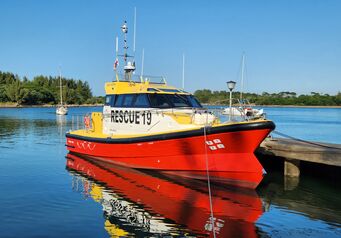
Norman Rautenbach, NSRI Richards Bay station commander, said: At 14h29, Monday, 19 October, NSRI Richards Bay duty crew were placed on alert to prepare for a maritime medical evacuation operation for 3 male seafarers injured onboard a 292-meter bulk carrier ...

A 48-year-old man from Belgium is expected to be discharged from hospital today after a non-fatal drowning incident at a remote beach between Brenton-on-Sea and Buffalo Bay on Monday afternoon. The man, on a cycling holiday with his family, is ...

On Saturday morning, NSRI Port Nolloth volunteers on a routine training exercise responded when a local mining vessel raised concern for three of her crew who had gone ashore on their RHIB (rigid hull inflatable boat) and not been heard ...